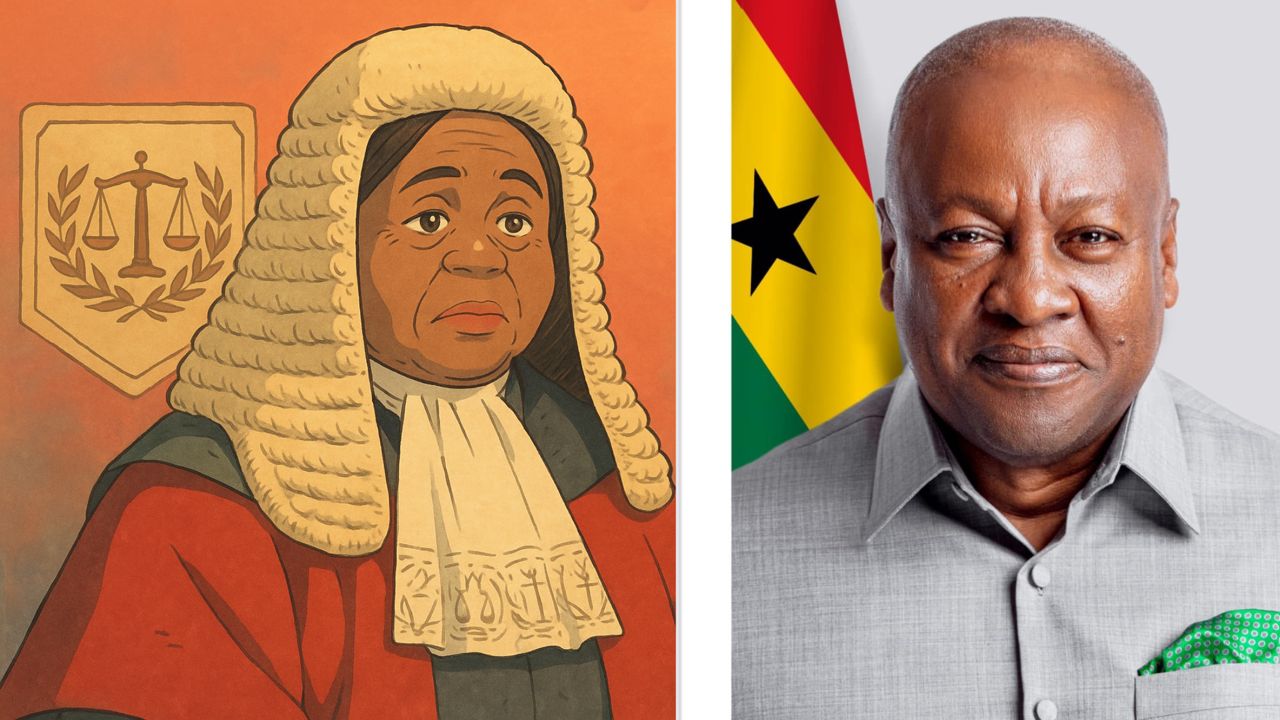
The president of the Republic of Ghana has removed the Chief Justice, Justice Torkonoo from office following a recommendation for her removal in the report submitted by the committee set up as part of Article 146 procedures to investigate petitions brought for her removal. The question on everyone’s mind, even within the legal community is, can the former Chief Justice resume her role as Justice of the Supreme Court even though she’s no more the Chief Justice?
There are two schools of thought on this issue.
- That the office of Justice of the Supreme Court (being a judicial role) and the office of Chief Justice (being an administrative office) are distinct and that removal from one is not coterminous with the other (Separate and distinct offices).
- That both offices are inseparable and removal as Chief Justice is removal from both roles.
In this article, I will address the separate and distinct offices school of thought which I identify with, and most importantly, speak to an observed lacuna that has made this a credible supposition.
THE SEPARATE AND DISTINCT OFFICES ARGUMENT
Justice of the supreme court first before appointment as Chief Justice
Article 128 provides for the composition of the Supreme Court and qualifications meriting appointment to the apex court.
- The Supreme Court shall consist of the Chief Justice and not less than nine other Justices of the Supreme Court.
- The Supreme Court shall be duly constituted for its work by not less than five Supreme Court Justices except as otherwise provided in article 133 of this Constitution.
- The Chief Justice shall preside at sittings of the Supreme Court and in his absence, the most senior of the Justices of the Supreme Court, as constituted, shall preside.
- A person shall not be qualified for appointment as a Justice of the Supreme Court unless he is of high moral character and proven integrity and is of not less than fifteen years’ standing as a lawyer.
The relevant parts of Article 128 (supra) reiterated by Section 1 of the Courts Act 1993 (Act 459), therefore is to effect that, the chief justice must first and foremost be a justice of the Supreme Court. In effect, a person who does not qualify as justice of the Supreme Court cannot be appointed as Chief Justice. This is an essential requirement because the Chief Justice is required by Article 128(3) and Section 1(3) of Act 459 to preside at Supreme Court sittings whenever available.
Office of Chief Justice is an administrative role
The constitution categorically states that the office of Chief Justice is an administrative and supervisory role. Article 125(4) states that: The Chief Justice shall, subject to this Constitution, be the Head of the Judiciary and shall be responsible for the administration and supervision of the Judiciary. The administrative functions performed by the CJ, quite distinct from the judicial role she plays when presiding as a justice of the apex court in its sittings has been demonstrated from the foregoing.
The distinguishing factors
- The distinguishing factors between the two are seen in qualification and function. To qualify as a Justice of the Supreme Court, one must be of high moral character and proven integrity and be a lawyer of not less than fifteen years’ standing. To qualify for appointment as chief justice, one need be appointed as a justice of the Supreme Court.
- To drive this point home, let us compare this to an established rule in company law. To be appointed a managing director in a company, one must first become a director in the company. One can remain as a director when the board votes to remove the person from the managing director role, but one cannot remain as managing director when he is removed as director.
DICHOTOMY OF TWO OFFICES, WHICH IS ANTICIPATED BY ARTICLE 146?
Now that it is established that the constitution explicitly and or impliedly draws a distinction between the two offices, I will consider article 146 in light of this distinction.
It can be reasonably argued that, in light of article 146 and in pursuance of the argument of separate and distinct offices, Article 146 of the 1992 Constitution of Ghana should provide a distinction between removal as Chief Justice and removal as Justice of the Supreme Court.
Even a cursory look at Article 146 will inform you that it only provides for the removal from office of the latter.
This leaves room for some purposiveness and extrapolation. Is it a lacuna? Does the constitution envisage or even acknowledge such a distinction? My interpretation and understanding is that the constitution does acknowledge the distinction but fails to provide for the removal of a Justice of the Supreme Court from the administrative office of Chief Justice.
Effectively, Article 146(6) of the Constitution 1992 only provides the procedure for the removal of a justice of a superior court when he is the Chief Justice. It is the procedure that is different, not the purpose.
Article 146 lists the grounds for the removal of a chief justice as follows:
- Incompetence as a Justice of the Supreme Court, or
- misconduct in the performance of duties as a justice of the Supreme Court, or
- is unable to perform the functions of a justice of the Supreme Court due to infirmity of body or mind,
What this construction portrays is an exclusion from the grounds, decisions he or she takes in her administrative role as Chief Justice. In effect, article 146 as it stands does not provide grounds or a process for removal from the distinct administrative office of Chief Justice on matters specifically the preserve of that office.
Article 146 as it stands exposes a lacuna in the law because clearly, the functions of both offices are different, and the grounds for removal from one or the other must be different. For example, incompetence in administrative function as Chief Justice does not automatically mean a person is also incompetent as Justice of the superior court, a judicial role. Incompetence as an administrator has no bearing on competence as a judge.
Hence, removal of a person from the office of Chief Justice should have no effect on their role as Justice of the Supreme Court unless Article 146(1) grounds (supra) exist, even though the reverse is not true because one has to be a Justice of the Supreme Court to be a Chief Justice.
THE WAY FORWARD
Whiles the Constitution envisages that the Chief Justice holds dual responsibilities as a Justice of the Supreme Court and as the administrative head of the Judiciary, it does not clearly articulate distinct removal mechanisms for these two roles.
This oversight may be remedied either by judicial interpretation applying Article 146 mutatis mutandis or, more ideally, through constitutional amendment to clearly distinguish the grounds and procedures for removal from each office. Until then, any removal of the Chief Justice from administrative office alone remains a constitutional grey area.
By: Joseph Naah-Yerreh (HND, BTECH, LLB)
REFERENCES
- Constitution of Ghana, 1992
- Courts Act 1993 (Act 459)
The contents of this page are for informational purposes only and doesn’t constitute legal or financial advice. Read our terms of use for more